About the Film
Director’s Statement
A Litany of All That’s Left insists on giving face, voice, and history to the impact of forced separation and mass incarceration as experienced in the American carceral system. People in prison exist in a space of profound invisibility. Most of what the public sees are headlines, crime statistics, court cases, and orange jumpsuits on the screen. We see people at the moment of their worst decision, forever tagged with the label attached to their conviction. What we rarely see are the human beings behind those labels—the parents missing their children, families carrying endless burden as they wait anxiously for a phone call from their loved ones, the sons and daughters grieving the loss of a parent, and those struggling with illness, trauma, addiction, mental health challenges, while still holding onto both hope and regret. A Litany of All That’s Left brings to the fore intergenerational trauma as communities endure the pain of separation and see their growth and resilience.
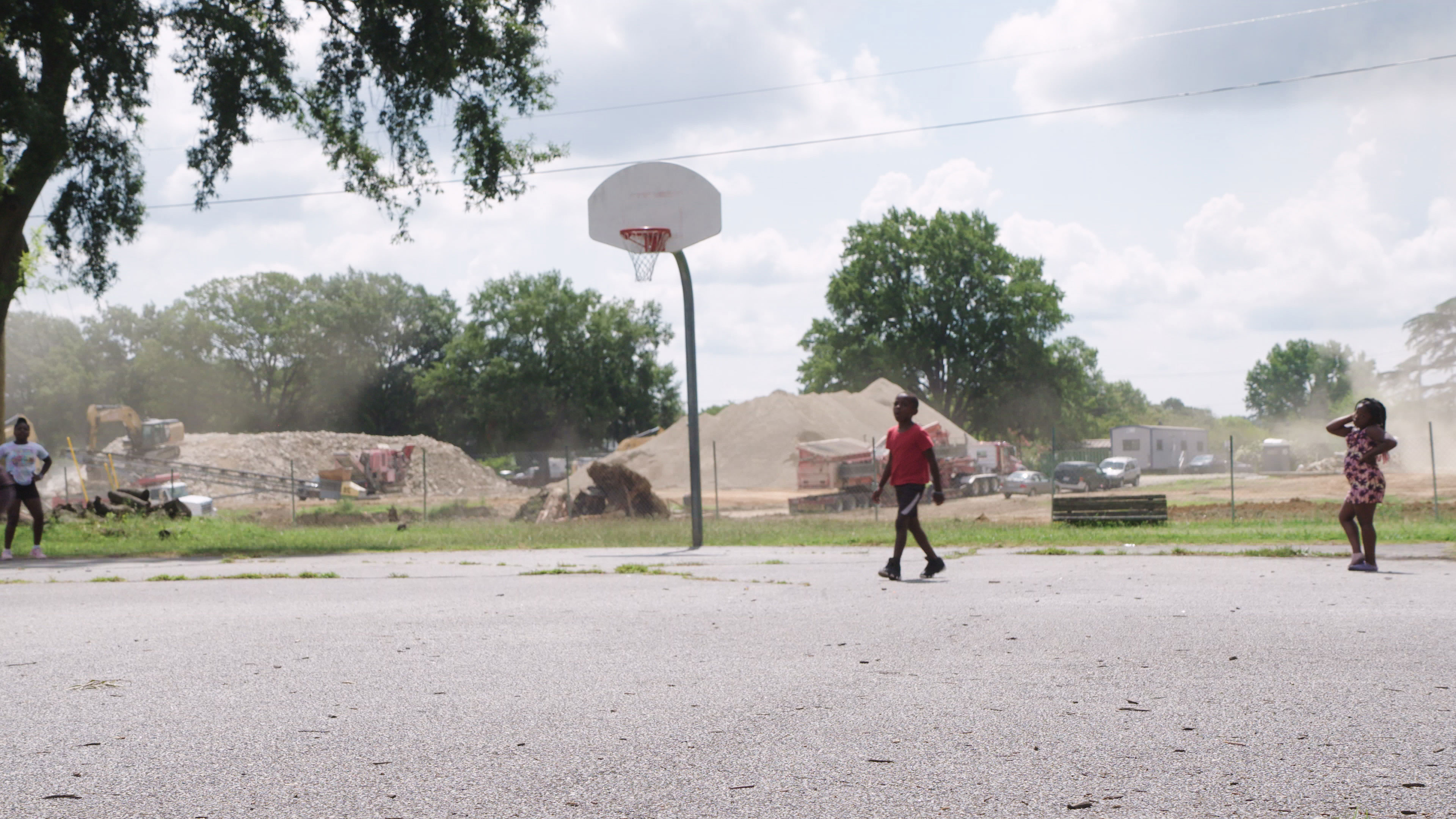
In contrast, a litany of all that’s left depicts the harm that exists and expands beyond the prison space. It traces how trauma, hope, and resistance circulate over time and beyond space. As the challenging realities of incarcerated individuals and families unfold, the film reveals the harsh magnitude of forced separation together with the racial and social implications of such realities. Indeed, the camera is entering this wound to reveal that there is more than pain and trauma when thinking about incarceration. The cinematography relishes the joy and warm connections that are part of the quotidian: simple moments of kids playing around a demolition site, short conversations with youth before a backflip, brief dialogue about love, and songs of community members outside a community garden.
The sound of the African drum that leads the last sequence at the end of the film, with the singing of Arthur Burton, has become the leading pulse of the film. The drum is not only a call for attention – bringing a community together for a litany, a litany of all that’s left – but is also a demand (and not a request for pity) for visibility and accountability. The sound of the moment when matters are breaking open. For how long will we accept the prison walls as borders, dividing “us” from ”them,” criminalizing “them,” and erasing and silencing so many from public view?
A Litany of All That’s Left is grounded in the revolutionary work of many activists and revolutionaries, including Shakil Ali, Kimberly Jenkins-Snodgrass, Jeanne Annarelli, Susan Kee, Hassan Shabaz, Arthur Burton, Askari Lumumba, Infinite Allah, and Margaret Breslau (The Coalition for Justice, VA), among many other artists, communities, activists, and visionaries across VA, who insist on seeing those who are often unseen, and those whose stories and challenges often go unheard. The communities we consider unseen take over the camera to tell their stories the way they want to. They speak to the judge who dehumanized and ignored their pain. They use words to speak about the anger and shame that is a direct result of being unseen, unheard, and unaccepted as equal. Their voice and eyes become another drum. Demand care. Matter. We matter. Can we see and take some collective and personal responsibility for the harm that we inflict on one another? Can we come to terms with the horrendous ways that incarceration impacts not only those behind bars but families, children, future generations, entire communities, and all of us as a whole? A Litany of All That’s Left demands a response. And an action. Well?
Yehuda Sharim
Yehuda Sharim is a writer, filmmaker, poet, and photographer. His work reflects on the relationship between the quotidian and the poetic to explore new potentialities of the imagination. Oscillating between fiction, improvisation, and real-life events, Sharim’s work offers an intimate portrayal of those who refuse to surrender amid daily devastation and culminating strife, presenting a vision of equality and renewed solidarity in a divisive world. He grounds his work firmly in the discourse of imagination, immigration, and displacement, shedding light on the shifting constructions of home and belonging. Sharim’s films and images explore new forms of storytelling, performative acts, dreams, and the lyrical potential of liberation with a precise aim: social and personal justice. His work also explores site-specificity and engages community members and untrained actors in reimagining social activism.
Sharim is the recipient of numerous grants and awards, including The Henry Luce Foundation, the National Endowment for the Arts, The Hellman Award, The Houston Endowment, The Houston Community Foundation, and several awards from the University of California Humanities Research Institute (UCHRI). Additionally, Sharim was an artist-in-residence at the Obama Institute in Mainz, Germany, and at The Coalition for Justice in Virginia. Sharim holds a bachelor’s in creative arts from the Hebrew University of Jerusalem, an MA in directing and performance from Goldsmiths College, an MA in Performance from NYU, and a Ph.D. from the UCLA Department of World Arts and Cultures. He first gained national attention with his feature-length documentary WE ARE IN IT (2016), which he completed at Rice University as a postdoctoral fellow. Sharim is currently a faculty member at the Global Arts, Media, and Writing Program at the University of California, Merced.
Scott Szabo
Scott Szabo is a film sound designer with over 20 years of experience. In 2015, Scott won Best Original Music Award from the Houston Comedy Film Festival for a feature called “Doll Factory.” In 2009, Szabo won a Telly award for music for the short film “Saving Evan White” and won a Gold Medal in 2005 at the Park City Film Music Festival for his score of “Dancing in Twilight.” Szabo has composed music for over 200 commercials and corporate marketing videos for companies including, Mahindra Tractors, Shell Oil, Enron, Continental Airlines, Joe’s Crab Shack, Applebee’s, and Time Warner.
Margaret Breslau
With her experience and long commitment to social justice, she works with Sharim Studio to produce films for social change, developing projects that bring people who have long been invisible and ignored into the light. She is Chair of the Coalition for Justice, a 501(c)(3) non-profit that supports and empowers people in disadvantaged and vulnerable communities. The work centers on human rights advocacy for people in prison and worker justice. She co-founded the Virginia Prison Justice Network (VAPJN), a network of groups in Virginia committed to ending mass incarceration. She is the production editor of ‘Unlocked: Art and Experiences From Inside Virginia’s Prisons”, a bi-annual journal of poetry, art, short stories, and reflections.
Taara Clarke
Taara Clarke is an Afro-Caribbean child therapist and first-time film organizer for Who but When, How. She is committed to social justice and continuous learning, which she brings into her personal life, media interactions, and therapy practice. In her therapeutic work, she views individuals as the experts of their own experiences. At Sharim Studio, she approaches film from a socially just perspective, centering people as experts of their own stories and fostering recognition of self and others. Taara holds a bachelor's in cognitive sciences from Rice University and a master's in social work from the University of Michigan.